

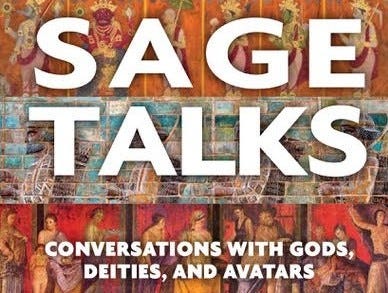
SAGE TALKS
Where Have All The Gods Gone?

The world we see is the myth we are in
—Patrick Harpur, The Philosopher’s Secret Fire
When we look up into the night sky and see the sparkle of stars, we are awed and enchanted. There is grace, there is wonder, and there is the excitement of the unknown. Everything comes alive with possibility. There is an enchanted world out there, and it beckons to us through a communal mystery. And we wish to respond to that call, for underlying all life is the urge for meaning. As human beings, we long for – we need – a sense of meaning and purpose in our lives. An enchanted universe serves to entice us with a feeling of belonging. Yet somewhere along the way we lost the sense of communion.
There was a time (“Once upon a time ...”) when humanity felt a common destiny with its abode, both terrestrial and cosmic, and this encouraged a mode of direct participation. Long ago, humankind experienced its habitat as an immersive space, an inclusive matrix that involved the individual in each moment of life. Our ancestors did not stand away from life – they participated directly in its enchantment. They were a part of life and not apart from it. This merger between being and abode established a psychic wholeness in humans. Our ancestors were not estranged from the world in the way that modern humanity is. In the last few centuries especially, humankind has increasingly expunged itself out of its own mystery and thrown itself out of the realm of enchantment. Modern scientific, rational consciousness is an alienated consciousness, afraid of its participation. It views the world as an outside observer; a world of objects that move in mechanical motion. This alienated consciousness has substituted enchantment and mystery with a smear of artificiality. The cosmos of human “being and belonging” thus became tainted with the contagion of the rational (or left-brained) human mind. Yet this is not how things are. It is only the latest picture of how things seem to us. We have been forced into constructing our meanings about a world we have let slip away from us. In other words, we have disenchanted ourselves from a living cosmos.
The modern landscape is now more scattered with administration than adventure. The inner psychological landscape of so many people has become infected with this weary contagion. We have now been put on guard to protect our psychic spaces, and to fend off forces that, intentionally or not, serve to damage and plunge our thoughts into despair. The game playing that has become a dominant part of our lives divorces us from our real sense of self, which then quietly retreats further inward into the deep recesses of our being. Modern life is now rife with false selves parading as authentic entities. This disenchantment has become a leading lens that looks out at the world around us – and at the cosmos too. We are told that everything is just one grand accident, a colossal conglomeration of chance and chaos. And this, we are constantly told, is just how life is.
The modern history of the industrialising world has been about the removal of mystery, mind, and magic from the realm around us. Modern Western consciousness defines itself by its very removal from the world “beyond”. It also unfairly labels all past thinking as not only incorrect, but primitive. That is, we tell ourselves that our understanding of the world has developed and improved in a linear fashion. Thus, all earlier thinking, concepts, and ideas were inferior and “unscientific”. Humankind has erroneously defined itself on a belief of linear progress, which is mechanical and immature. Previous worldviews are seen as misguided, illegitimate, and lacking sophistication. And yet, we wonder little about how our descendants will look back upon our own current prognosis.
In such moments of sociocultural transformation, when bases of knowledge are revised and our constructions of reality questioned, the need to seek the self grows stronger in the individual. In such transitional times there is urgency, opportunity, and an interior push to reconnect with a sense of meaning, both personal and cosmic. During such times of change and uncertainty, the impulse for meaning and significance becomes a more prominent and necessary urge. In other words, there is a fundamental need to understand one’s self and its place in the larger scheme of things. The instability we encounter in the world around us only convinces us further of the need to find the roots that connect us with a more permanent stream of knowledge and meaning.
Once upon a time . . .
Once upon a time … when conscious, reflective thought arose within humanity, all our mental enquiries were unified into a single stream that was an inherently sacred quest. We longed to know the origins of existence. Philosophy and science were once the same endeavour, and they existed alongside a metaphysical thirst. The human spirit longed to seek beyond the rhythm of the stars and their orbits. Our ancestors watched and tracked the cycles of day and night, the great arc of star-sprinkled skies, and the heavenly revolutions. From this they calculated a measurement of time, mathematics, and reason. And with these tools they expanded the mind’s reach to traverse the possibilities of life with its whys and wherefores, endlessly searching once again for the original stream of our origins. It is the spirit that seeks and calls out, wishing to know and be known, and it is society that clothes the spirit in coloured rags that change with each season’s fashions. We’ve come to wear so many layers upon us that we hardly have any remembrance of being naked. And yet the soul of humanity, the soul of the world, has never ceased to be the essential driver that propels us further.
For thousands of years in cultures across the globe – from the ancient Egyptians to Mesoamerica – divination, myth, ritual, and direct intervention with the gods all formed part of the holistic human experience. Dealings with phenomena beyond materiality informed the psychological and spiritual development of human beings. Such mythology constituted a healthy and integral part of human consciousness. Such a premodern consciousness was also one where the ego was kept in check by the presence of powerful transcendental forces that were believed to play a permanent part in human lives. Such transcendental powers were perceived as being the real players behind human existence. And such powers were not only acting upon human beings externally but also formed a part of their interior psyche. As such, aspects of the individual – their thoughts, feelings, desires, and intentions – were not as strongly developed and manifested as they are today. In such ancient times, humankind was not considered apart from such powers, energies, or influences in the way that the modern individual believes today. This integration within the cosmological order created a natural sense of enchantment.
Yet by the first century CE, the essayist Plutarch was asking, “Why is it that the gods are no longer speaking to us?” By that time, there had been a steep decline in the prestige of the oracles and the divination that was once held so prominent in Greek culture. However, a great majority of people still believed that their lives, both internal and external, were influenced by forces beyond them, those forces which also infused their souls. For millennia the boundaries between inner and outer, and between subjective and objective, had become blurred. One did not know where to place the dividing lines, if indeed there were any. The external world of nature and the inner world of the human psyche were inextricably merged, and both were spiritualised in their own ways. And yet the process of separation was already under way. Rather than being inextricably bound together, the realms became seen as attached through forms of correspondence.
The medieval world – coming after the premodern (or antiquity), and before the modern period – contained within it a stream of consciousness that retained a link to the notion of correspondence. In this context, correspondence implied that things of the world had relations of sympathy between them. Just as women attract men, minerals meld with other minerals, and molecules attach together, so too do sympathies exist between elements of the cosmos and the earth – a Hermetic “as above, so below” set of relationships. Resemblance and sympathy were known aspects in the medieval mindset, although the Church orders worked hard to expel them on charges of heresy. Thus, many of these practices were termed “occult” and driven underground.
The modern mind wished to take a step back and to see things in isolation, and not to confuse the relation of things. Those minds that could not agree on the “consensus” relations were deemed mad or paranoiac. And thus, the understanding of correspondences eventually went into survival mode and slipped below the external membrane of medieval life. And through this, the Middle Ages grew stagnant, as there was little movement in creative vision, myth, and the innovative ideas that propelled cultures forward.
Human consciousness over the centuries has been undergoing a decoupling from the world around it; a distancing that has been referred to by the German philosopher Friedrich Schiller as “disgodding” from nature. This involves our human nonparticipation with an integral cosmos and creating a distance between human beings and everything else. In short, humanity succeeded in taking itself out of the picture by creating a new and different picture of itself. A new modern world was being constructed that viewed progress separate from the meaning and metaphysical significance of the individual. With the cosmos as something within concrete laws, the latest pioneers of humankind could continue unabated with their goals of conquest and competition. A new type of consciousness had seated itself at the forefront of human social development.
Despite the westernised mode of linear progress, human civilisation has largely been in a state of instability and crisis for several centuries. The modern schismatic consciousness that has been embraced as being “normal” has led us to the present state of world volatility. The last few centuries were a single evolutionary episode that ran its course. In anthropological terms, it was a mere blink of an eye. And in that blink, humanity brought itself to the brink of collapse. Yet at the very last step, we may just succeed in stepping back from this brink … if we can establish a new form of cosmic communion.
The great sacred mirror of the human self is reflecting back to us every known atom that ever sprang out of the creative matrix of existence. It is an epoch for momentum, acceleration, exposure, disclosure, invention, innovation, exploration, and gnostic understanding as never before on such a widespread scale. Despite the last gasps and squirming from certain malevolent forces, it is a truly miraculous age for us, here and now, to be witness to what is unfolding. Let us not forget that life is a gift …
Sage Talks: Conversations with Gods, Deities, and Avatars will be published on 31st March (Aeon Books). Readers of this Substack can get a 20% discount if they order from the publisher direct - until 30/04/26 - both in the UK and the US at links below by using this code at the checkout: ST20
(UK): https://spirit.aeonbooks.co.uk/product/sage-talks/95400
Caught a glimpse of a few summer migrant birds. Definitely not swallows. Swifts or house martins. Very unexpected in early March, especially in the north of Ireland.
This very interesting and long account of the human condition and our fabrication of reality in order to control it, ends beautifully with a proclamation “Life Is A Gift”… wrapped in a bit of mystery, leaning into something next…
Well done! 👍🏻